


Vibe Coding at Enterprise Scale: Why AI Needs Business Context, Not Just Better Prompts
Vibe coding means describing what you want in plain language and letting AI write the code for you. Andrej Karpathy coined the term in February 2025, and by November, Collins had named it Word of the Year. The idea spread quickly because it works: people who couldn’t ship software before now can.
For example, a product manager at a large insurance company has an idea for a self-serve policy change flow. Thanks to AI, they can type what they want into an AI app builder on Tuesday afternoon and have a demo ready for stakeholders the next day.
Using AI in software development has made coding faster and more accessible. That’s real progress. However, people who can code know that this way of working has its limitations.
At enterprise scale, it exposes two failures that used to hide inside long delivery cycles. This article separates them and answers one question: when AI-built work goes wrong, which problem do you have, and what fixes it?
Key Takeaways
- AI-assisted software development has cut the cost of building software, but not the cost of building the wrong thing.
- Two different failures emerge: intent gaps (building what nobody needs) and context gaps (building the right thing without the rules to build it well).
- Teams fix intent gaps upstream by establishing clear product priorities, creating problem-first briefs, and agreeing on success metrics before anyone prompts.
- Context gaps are fixed by capturing real data, turning AI business-specific context into a shared source, and checking output against company rules.
What Changes When Vibe Coding Reaches Enterprise Scale
AI coding tools have been widely adopted at companies of different sizes and growth stages. The 2025 DORA report found that 90% of technology professionals now use AI at work. Gartner reports that most engineering leaders see productivity gains, with a net average gain of 19.3%, and says lasting gains depend on matching workflows and governance.
But scale changes what a mistake costs.
In a startup, a team can spend an afternoon on a wrong feature and then delete it and move on. In an enterprise, a mistake can become code that someone has to review, secure, maintain, support, and explain to an auditor. The DORA report puts it plainly: AI speeds development up, but that speed can expose weak spots later.
Cheaper to Build Is Not Cheaper to Own
The problem of building things nobody uses is not new. Pendo's 2019 Feature Adoption Report found that 80% of features in the average software product are rarely or never used, while about 12% of features generate 80% of daily use. That was before AI made features cheaper to produce.
When building gets cheaper, the brake that used to stop weak ideas disappears. Long backlogs and scarce engineering time were frustrating, but they forced teams to choose. Remove that friction and the number of features rises, while the number of people who can review them does not.
This is why the DORA 2025 research describes AI as an amplifier. It magnifies what a team already does well and what it does badly. A team with clear priorities and good knowledge of its systems ships more good work. A team without them ships more of the wrong thing, faster.
Two Problems That Look Alike: Intent Gaps and Context Gaps
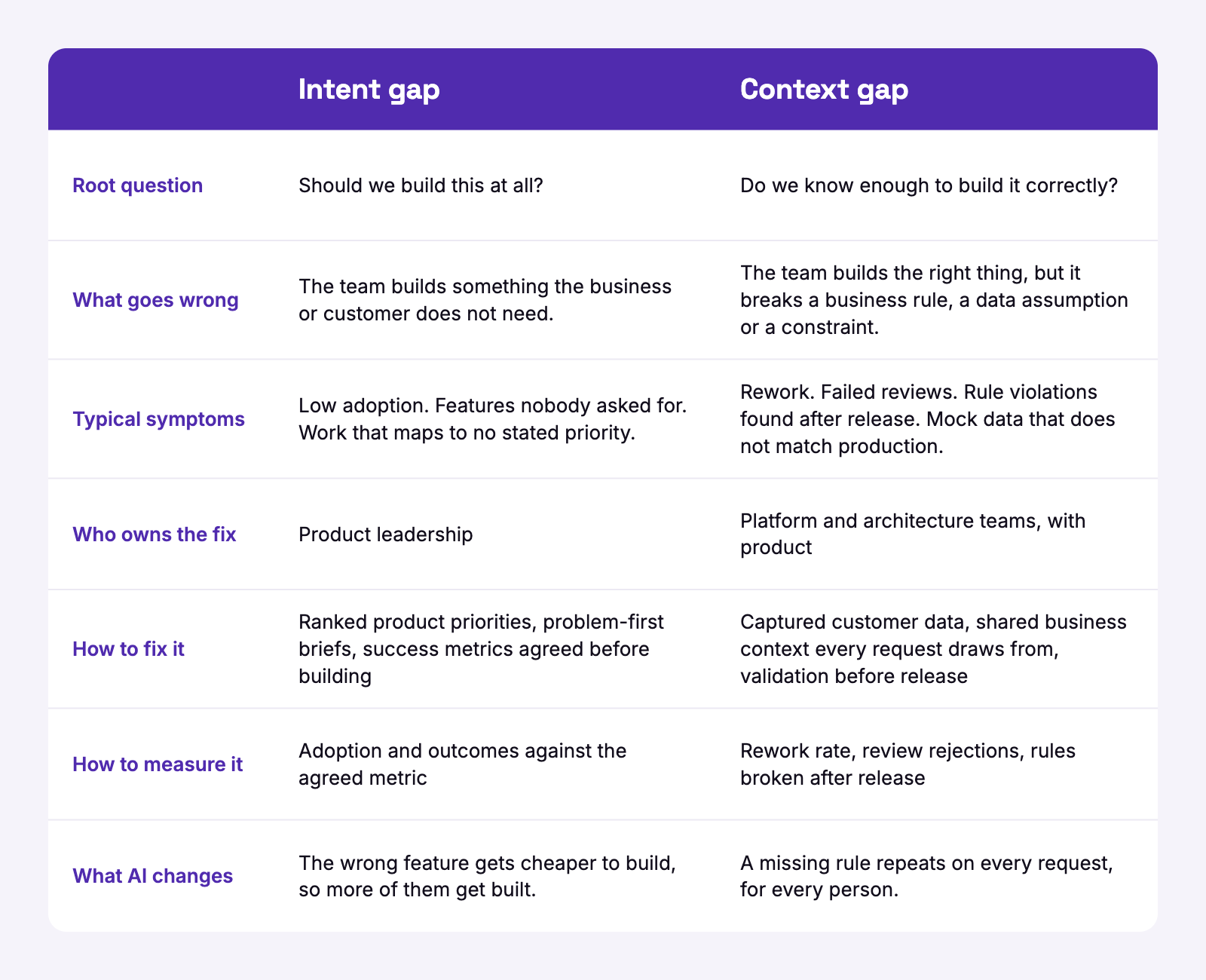
When AI-built work misses, the failure usually belongs to one of two categories.
An intent gap happens when the team builds something the business or customer does not need. The software may work perfectly; it just shouldn’t exist.
A context gap happens when the team builds the right thing but lacks the customer information, business rules, or constraints to build it correctly. The idea is sound, but the execution breaks something the company already knew.
From the outside, both look like they can be justified by “AI built the wrong thing”. Underneath, they have different owners and different fixes.
How to Tell Which Gap You Have
Four questions sort most cases:
- If the feature worked perfectly, would anyone use it? If not, you have an intent gap. No amount of context will fix it.
- Can you name the priority or metric this work supports? If nobody can, the intent gap started before the first prompt.
- Did it break a rule someone in the company already knew? An access rule, a price cap, an approved library, a legal rule. If yes, you have an AI context gap.
- Was it built against real data and real systems? If developers built it on mock data, a context gap is likely to hide until production.
Some features can carry both gaps. In those cases, fixing the intent gap is the priority. Building the wrong thing correctly is still building the wrong thing.
Intent Gaps: When AI Builds What Nobody Needs
The clearest evidence of intent gaps comes from DORA's AI Capabilities Model. Among the seven capabilities it identified, one stood out: a user focus. Teams with a strong focus on users saw AI improve their work. Teams without one saw AI adoption hurt team performance.
The reason is simple. As DORA's own guidance puts it, speed is irrelevant when you're heading the wrong way. AI does not decide what is worth building. It just builds what someone asks it to build.
That means intent gaps are not an AI problem, and a better model will not close them.
How to Fix Intent Gaps
Intent gaps are a product leadership problem, and they are fixed before the first prompt is typed out.
Set Product Priorities Before Anyone Prompts
When a feature takes weeks to build, the backlog does the choosing for you. When it costs an afternoon, it does not. Teams need a visible, ranked list of what matters this quarter, so that cheap features still have to earn a slot. If a request maps to no priority, the speed of building it is irrelevant.
Write Briefs That State the Problem, Not the Feature
A prompt describes a solution. A good brief describes a problem: who the user is, what they are trying to do, what is getting in the way, and what is out of scope. The brief is the input the prompt should come from, not the other way round. It also gives reviewers something to check the output against.
Define Success Metrics Up Front
Before building, agree on what would prove the feature worked: an adoption target, a task finish rate, or a drop in support tickets. Also agree on when the team will remove the feature if it misses. Cheap features are only cheap if the ones that fail are retired instead of kept forever.
Context Gaps: When AI Builds the Right Thing Wrong
Context gaps are harder to spot, because the idea is right and the output often looks right too. What is missing is AI business-specific context: the knowledge a system needs to produce work that fits how a company works.
That context falls into three groups:
- Customer information: Real data shapes, customer segments, and edge cases. A loan flow built on sample data will not know that a quarter of real applicants have joint accounts.
- Business rules: Eligibility rules, pricing caps, approval thresholds. The insurer in our opening example had a rule about mid-term coverage changes. The person who prompted the feature did not know it, so neither did the AI.
- Constraints: Legal rules, system limits, approved libraries, security policies. These rarely appear in a feature request because the people who know them are not the ones writing the request.
DORA's research points the same way. Its AI Capabilities Model found that connecting AI tools to internal data and company-specific context raises their impact on effectiveness and code quality. That is the shift from prompt engineering to context engineering.
How to Fix Context Gaps
Left unfixed, context gaps compound. Every team that works without the rules builds a slightly different version of the same thing, and those differences become engineering drift.
Capture the Data, Not Just the Request
Build against real backends and real data structures, not mock data. A demo built on fake data hides the context gap until it reaches production, where the people who know the real data catch it at once. The earlier the real data enters the build, the earlier the gap shows.
Make Business Context Shared, Not Personal
Most business rules live in someone's head, or in a document only one team reads. As we covered in Unwritten Rules, much of the knowledge AI needs was never written down at all.
The fix is to turn that knowledge into a shared source that every AI request draws from, with named owners who keep it current. This is AI business context refinement as an ongoing practice: we add, correct, and retire rules as the business changes, rather than capturing them once and letting them age.
Validate Against the Rules Before It Ships
Even with shared context, output needs checking against the rules it was meant to follow. That means review gates for high-risk changes, conflict checks when new guidance contradicts old rules, and a record of who prompted what. Good AI enterprise governance makes it clear who owns AI-generated code and gives every change an audit trail.
Why Better Prompts Don't Close Either Gap
The usual response to bad AI output is to write a better prompt. For one person on one task, that helps. At enterprise scale, it fails for a structural reason: a prompt belongs to one person, in one session, and then it’s gone.
A prompt can't carry strategy. The writer may not know this quarter's priorities. A good prompt for an unneeded feature still creates an unneeded feature. That is the intent gap.
A prompt can't carry the company's full rule set either. No one can type every access rule, approved library, and legal rule into every request, and two hundred people will each leave out different ones. That is the context gap.
Bigger models and larger context windows don’t change this. A smarter model, given the wrong context, still produces the wrong result. That is why context beats model quality as an enterprise strategy. What matters is if the right rules apply to the model for every request.
Where DesignVerse Fits
DesignVerse closes the context gap. It generates software within your existing architecture and standards, from the repos, docs, design systems, and business flows your company already has. Before a request reaches the model, the needed rules are gathered and attached, so the output follows them from the start.
For product teams, that means building against the real backend, not mock data. What they ship is working code that engineering gets as code, not as a ticket to rebuild. For engineering teams, it means that approved libraries and conventions apply without requiring each person to know them. Every prompt is saved as a tracked version, so changes can be traced and reviewed.
It does not close the intent gap, and it should not. Deciding what is worth building stays with product leadership. DesignVerse ensures that once you make the decision, the team builds the work the way your business requires.
Conclusion
When AI-built work goes wrong, ask which gap you are looking at before you reach for a fix. Deciding better fixes intent gaps by establishing clear priorities, creating problem-first briefs, and agreeing on success metrics in advance. Knowing more fixes context gaps: real data, shared business context with named owners, and validation before release.
AI makes both gaps cheaper to ignore and more costly to leave unfixed. The teams that get value from AI-assisted software development will be the ones that close both, not the ones with the best prompts.
After you’ve identified what type of gap you have, find out how much engineering drift is costing you, then request a demo to see how DesignVerse can help you close it.
FAQs
What is vibe coding in an enterprise context?
Vibe coding means describing software in plain language and letting AI write the code. In a business, the same method must create work that fits current systems, rules, and compliance needs. A single prompt rarely achieves this.
What is the difference between an intent gap and a context gap?
An intent gap is building something the business or customer does not need. A context gap is building the right thing without the data, rules, or constraints needed to build it correctly. Product leadership fixes intent gaps, while shared business context and validation address context gaps.
What is AI business-specific context?
The knowledge an AI system needs to produce work that fits a particular company includes customer data, business rules, architecture, approved tools, and constraints. Without it, AI falls back on public defaults.
Can better prompts replace business context?
Not at scale. One person writes a prompt for one task, and it can't reliably carry a company's full set of rules. We need to store, own, and apply the business context to every request automatically.
Who should own business context for AI-assisted software development?
One or two designated owners, usually from the platform or architecture team, working with product. They add, update, and retire rules, and resolve conflicts when new guidance contradicts existing standards.