


What Is Context Engineering? Solving Enterprise AI's Biggest Bottleneck
In the open source project Dagu, a file intended to guide AI coding assistants pointed to a function called runDAGs. There was just one problem: the function was no longer present under that name in the codebase. It appeared to have been renamed during a rewrite of the user interface. It was like a one-sided breakup: the code had moved on, but the instructions hadn’t.
This was one of the examples documented in a June 2026 study on context rot. Researchers examined AI instruction files across 356 Github repositories, including CLAUDE.md, AGENTS.md, and .cursorrules. An automated check flagged outdated code references in 23% of the repositories. Of 50 flagged references manually reviewed, 32 were confirmed as genuinely outdated. These preliminary findings don't measure how often AI produced faulty code, but they highlight a familiar engineering problem: documentation doesn’t always survive the next code update.
Now scale that problem to an enterprise, where an approved API change lives in Jira, a security exception is buried in Confluence, and the coding assistant is reading last month's Markdown file. What should have been a straightforward update can quickly turn into hours of investigation, debugging, and rework. And the problem might only be discovered during code review, precisely when the engineering team thought the hard part was over.
In 2026, the enterprise AI discussion is shifting from bigger models and smarter prompts to context engineering: giving AI systems accurate, relevant, continuously governed knowledge throughout software creation. The real bottleneck isn’t always code generation. It’s everything the model needs to know before writing code that belongs in production.
Key Takeaways
- Context engineering goes beyond better prompts. It connects architecture, code, documentation, and business requirements into a reusable foundation for AI.
- Static instructions can become stale. A valid skill today may contradict tomorrow's approved architecture.
- Ground truth requires decisions, not just timestamps. The newest valid source normally takes precedence, but exceptions and conflicts need ownership.
- Governance improves efficiency. Retrieving relevant information avoids wasted tokens and contradictory instructions.
- The real goal is less rework. Time to an approved, production-ready change matters more than first-draft generation speed.
What Context Engineering Actually Means
Gartner describes context engineering as designing and structuring the data, workflows, and environment AI needs to understand the intent and produce enterprise-aligned outcomes. For teams weighing context engineering vs. prompt engineering, the distinction is simple: prompt engineering improves the request, context engineering makes sure the AI has the knowledge to act on it.
As InfoWorld argued in November 2025, the competitive advantage in enterprise AI increasingly comes from proprietary data, business workflows, and domain knowledge rather than model choice alone. Two companies can use the same LLM and get very different results. It's why a context-first enterprise AI strategy starts with organizational knowledge, not just a model shortlist.
For engineering teams, that means bringing codebases, Markdown documentation, Confluence, Jira, API contracts, and business workflows into a shared context engineering layer that can serve different LLMs.
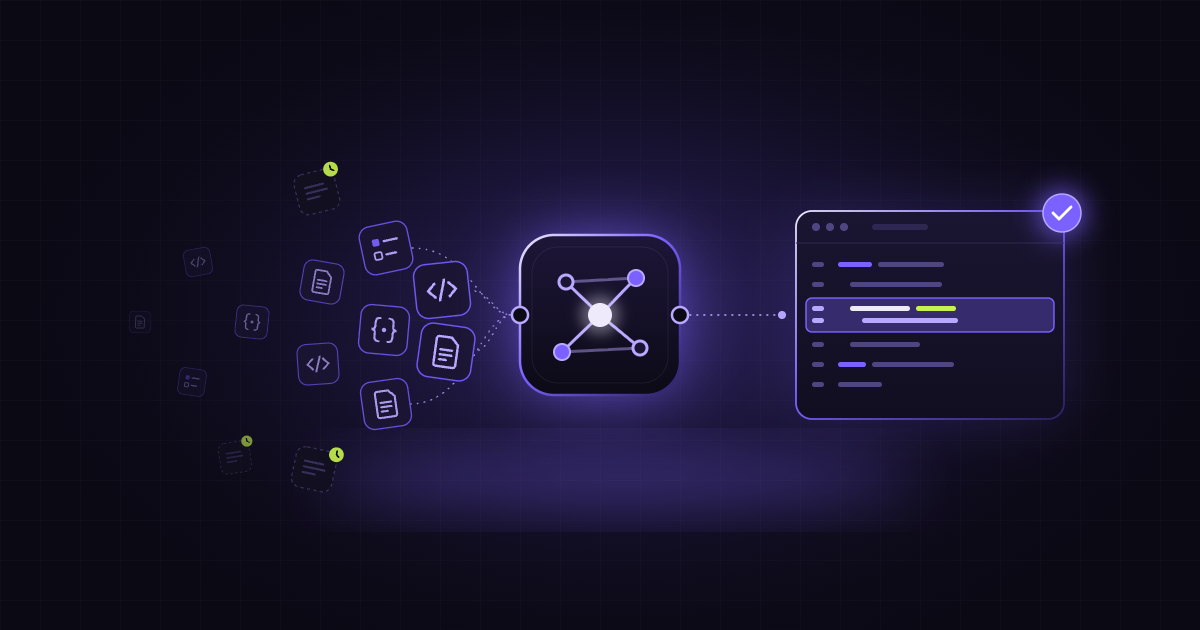
It isn’t just a searchable document dump. A graph-based system works like a map of a company's software, showing how different components, requirements, and rules are connected. For example, when a developer asks an AI assistant to update a feature, the system can identify which other parts of the software might be affected and which rules the change must follow.
This matters across the entire software workflow, from interpreting a requirement to generating code, selecting tests, and reviewing whether a change fits existing architecture. A model may be excellent at TypeScript, but that doesn't mean it knows which internal library your platform team stopped supporting on Tuesday.
Why Skills and MD Files Aren't Enough
Files such as SKILL.md and AGENTS.md help teams codify conventions and teach AI assistants repeatable workflows. They're extremely valuable, but they're also snapshots.
This is critical across many business sectors:
- In banking, changes to payment-processing rules can affect fraud detection and compliance requirements.
- In aviation, an interface update can affect safety-critical dependencies.
- In traffic management, a new integration can change routing or signal-control constraints.
- In healthcare, changes to patient data access rules can affect clinical workflows and patient privacy.
A static file cannot independently discover that an authoritative decision changed elsewhere. Treat instructions as part of the context system, not as its sole source of truth. They need owners, version tracking, and links to the code and policies they describe.
The Problem of Stale Context
Consider an authentication skill that tells AI coding assistants to use version 2 of an internal library. The security team approves version 3 and updates its standard, but a cached version of the skill remains retrievable. The assistant generates code that compiles, passes basic tests, and fails the organization's current security requirements.
No exotic AI hallucination is required. The assistant followed the instructions it was given. Unfortunately, those instructions belonged to a previous release.
Stale context is particularly difficult because it looks credible: a real file, an internal author, a familiar pattern. It’s like cooking from an old version of your grandmother’s recipe: the dish looks right, but she changed a key ingredient years ago and never told you. It tastes different, and you have no idea why.
A 2025 study published at the Association for Computational Linguistics found that outdated information can lead AI systems to produce incorrect answers, even when up-to-date information is available. Upgrading the model won't solve the problem if it keeps relying on the same outdated sources.
Establishing Ground Truth
A production context layer needs to distinguish the most recent document from the newest valid, authoritative information. Those aren't necessarily the same thing. Yesterday's unapproved draft shouldn't automatically override last month's signed-off architecture decision.
Sources should carry timestamps, versions, approval status, ownership, and relationships to affected components. When two instructions collide, the system can establish whether one supersedes the other or whether they apply to different environments.
However, not every conflict can, or should, be resolved automatically. Suppose the security team approves a new authentication library, but an older application still has permission to use the previous version until its migration is complete. Simply choosing the newest instruction could lead to the wrong implementation. A governed enterprise context layer should identify the contradiction, show which sources and systems are affected, and flag the issue for the responsible engineering team.
Much like a Git merge conflict, both versions remain visible until someone with the appropriate authority decides which one applies. That decision then becomes part of the system's context, so the next AI-generated change follows the approved rules instead of reopening the same debate.
Who Controls the Data
An organization's context contains valuable intellectual property: architecture, internal dependencies, approved patterns, and business processes. Engineering leaders should know who controls it, and what happens if they switch model providers.
A client-controlled layer should support adding, updating, and deleting sources; permission management; version history; and content hashes that help verify changes. Audit records should show which source versions informed an implementation. Export, retention, and deletion rules must also cover derived context, not just original documents.
These are AI governance and sovereignty questions, not just technical preferences. Vendor lock-in is harder to avoid when the company's accumulated engineering knowledge is trapped inside a proprietary assistant. Context should remain an enterprise asset.
Why Efficiency and Governance Go Together
Giving a model the whole engineering wiki isn't context engineering. It's an expensive reading assignment, with no guarantee that the useful page will win its attention. Even a large context window only increases how much text a model can process; it doesn't decide what's current or relevant. Understanding the difference between context windows and context engineering is essential to building reliable enterprise AI systems.
A practical context pipeline has three stages:
- Retriever: Finds potentially relevant code, documentation, requirements, and connected systems.
- Re-ranker: Prioritizes those results by relevance, authority, and applicability.
- Evaluator: Checks whether the selected context is sufficient and consistent, retrieving more evidence or requesting human review when needed.
For an API change, the retriever finds its specification and dependent services. The re-ranker favors approved requirements over outdated design notes. The evaluator checks whether a migration constraint is missing before the model starts coding. That’s AI context management as an ongoing process, not a one-off upload.
This also challenges the assumption that bigger models are always better. Gartner predicts that by 2027, organizations will use small, task-specific AI models at least three times as often as general-purpose LLMs. Smaller models can offer faster responses and lower computational costs for specialized tasks. But they still depend on accurate, relevant enterprise knowledge. A smaller model with the right context may be more useful than a larger one working with incomplete information.
The Real Cost of Ungoverned Context
Some enterprise AI workflows can have read-to-write token ratios ranging from 10:1 to 150:1. These are illustrative operational figures, not a verified industry average. At 100:1, producing 1,000 output tokens entails reading roughly 100,000 input tokens.
Complex software tasks demand plenty of reading. But repeatedly fetching duplicate files, irrelevant services, and outdated instructions increases cost and latency without improving the result. Contradictions can also derail the implementation.
In a 2026 vendor-run evaluation, AtScale reported that a governed semantic layer improved accuracy on business-data questions by roughly 1.7, 2.4 times across the models tested. This wasn't a code-generation benchmark or independent validation. Still, it illustrates why enterprise AI accuracy depends on the quality and organization of context, not just model capability.
Less Refactoring, Less Manual Alignment
Every engineering lead knows the pull request that looks ready until somebody asks why it uses an unapproved dependency, duplicates an existing service, or ignores a platform convention. Now imagine those pull requests arriving at machine speed across ten teams.
The bottleneck shifts to code review, quality assurance, cross-team clarification, and rework. Those hidden costs of generic AI models rarely appear on the software subscription invoice. Counting generated lines tells you little about whether the changes will survive those stages.
DesignVerse approaches this problem through an engineering context layer that connects organizational architecture, design systems, standards, and product logic before generation. Its aim is to make approved implementation patterns reusable and consistent across teams, rather than rediscovered through prompts and corrected late in review.
Human testing and approval still matter. The goal is to give reviewers fewer avoidable problems to find, so they can focus on the ones that actually require judgment.
Beyond Software Development
The same foundation could become an operating system for context across knowledge-heavy workflows: a shared graph of information and relationships, retrieval mechanisms, and governance that determines what each application may use.
Healthcare illustrates both sides. Developers creating hospital software need current API specifications, security policies, and standards for sharing information between systems. An authorized administrative assistant may need referral procedures, scheduling rules, and departmental responsibilities. The workflows differ, but both depend on current, permissioned, traceable information. Clinical applications would also need additional privacy protections, safety checks, and professional oversight.
Instead of rebuilding disconnected knowledge stores for each tool, organizations can reuse governed context while respecting different access requirements.
Conclusion
Enterprise AI doesn't struggle only when models write bad code. It also struggles when they produce plausible code based on outdated rules, missing dependencies, or contradictory instructions.
Context engineering addresses what happens before code generation: connecting knowledge, establishing ground truth, and providing the right constraints for the task. A governed, client-controlled layer cannot eliminate bugs or replace quality assurance. But it can reduce the preventable work between an impressive demo and a production-ready change.
For CTOs, the better question isn't how many lines of code an assistant can produce, it's how many survive review.
Explore DesignVerse's Engineering Context Layer and book a demo to see how it could fit your engineering environment.
FAQs
What is context engineering in AI?
It is the practice of selecting, organizing, updating, and governing the information and tools an AI system needs to complete a task reliably.
How is context engineering different from prompt engineering?
Prompt engineering improves how you ask. Context engineering manages the sources, rules, and relationships the model needs to respond correctly.
Why does AI-generated code need so much rework without it?
An assistant may miss current dependencies, architecture decisions, security standards, or business requirements. Code that works alone may still fail integration or review.
What's the difference between a retriever and a re-ranker?
A retriever finds candidate information. A re-ranker orders it by relevance and authority so the model receives the most useful material.
How does an engineering context layer handle conflicting information?
It tracks source versions and approvals, applies valid rules where possible, and escalates unresolved conflicts to responsible human owners.
Can context engineering be applied outside software development?
Yes. Healthcare, logistics, analytics, and operations also depend on current organizational knowledge, appropriate permissions, and traceable decisions.