


Context Windows Aren't Context Engineering: The Difference Enterprises Keep Missing
%20(1).png)
"Our model has a 1M-token context window." It sounds like a major advantage for enterprise engineering teams; after all, more capacity means the model can process more code, documentation, instructions, and conversation history at once.
However, a larger context window alone does not guarantee reliable or standards-aligned AI output. Even when a model can process more information, it may still rely on an outdated internal library, overlook cross-team dependencies, or fail to follow established engineering standards. The real limitation, therefore, is not simply how much information the model can hold, but whether the right, current, and organization-specific knowledge is available at the point of use.
That is where context engineering comes in. It determines what information the model needs and how that information is made available for the entire task. A larger context window increases capacity; context engineering determines how that capacity is used.
In this article, we break down the difference between context-window capacity and real organizational context, and why that distinction matters for enterprise AI.
Key Takeaways
- A context window is the amount of information, measured in tokens, that a model can process within an interaction. It is a capacity limit, not a measure of organizational understanding.
- Larger context windows are useful, but more tokens do not automatically mean better context.
- Enterprise AI tools commonly lack four forms of context: architectural and technical standards, business and domain rules, security and compliance requirements, and institutional knowledge.
- Context engineering manages the information supplied to a model throughout a task. A persistent enterprise context layer can support that work across teams.
- For enterprises, context is an infrastructure problem, not simply a model specification.
What a Context Window Actually Is?
IBM's definition of a context window refers to the amount of text, measured in tokens, that an LLM can consider or remember at once. Prompts, previous messages, documents, source code, and instructions all compete for space within that window. A larger window lets developers provide more files, include longer documents or retrieved information, and retain more conversation history.
However, none of that means the model has acquired organizational knowledge. Consider an agent modifying an internal API. Even if its window holds the entire repository, consumers may live elsewhere, a compatibility rule may come from a previous incident, and the approved pattern may sit in an internal standard.
A bigger window can hold those facts, but it can't discover information the surrounding system never gives it.
Why Bigger Context Windows Feel Like a Fix
The instinct is reasonable: if missing information causes weak output, provide more information.
Sometimes that works. If an engineer already knows which files matter, more space reduces the need to split or summarize them.
The reasoning breaks when “more information” becomes interchangeable with “better context.” This gap between token capacity and real AI context is exactly where enterprise tools fall short. Enterprise systems contain far more information than any individual task needs. The difficult part is selecting what is relevant.
This shows up in how other reputable sources introduce the topic, too. McKinsey makes a related point for enterprise leaders: expanding a model's context window is one useful lever, but it works alongside existing data practices and planning rather than replacing them. Zapier's explainer lands on the same idea from a more practical angle; windows keep growing, but a bigger one doesn't automatically produce a better result.
Freshness matters too. An architecture document can fit comfortably inside a context window and still describe an API that changed last month. More room helps when the constraint is space. It does not solve relevance, freshness, relationships, permissions, or retrieval.
What “Context” Actually Means for Enterprise AI
For enterprise AI, context is the organizational knowledge an LLM needs to act correctly within the environment it is changing.
Suppose an engineer asks an agent to replace a legacy component. Relevant context includes the code, approved replacement, downstream dependencies, service ownership, migration plans, deployment constraints, and an exception created after an earlier incident. The difficult part is often not understanding those artifacts individually, but how they are connected.
This is why context engineering cannot be reduced to putting company documentation inside a large prompt. In context engineering, "context" is information drawn from instructions, memory, external knowledge, tools, tool results, and structured sources. The engineering problem is deciding what enters the model's context and how.
But there's an added challenge. Information changes, from evolving repositories and reorganized teams, to updated security requirements to undocumented incidents. Useful enterprise context, therefore, has to be structured, reasonably current, connected to the systems where the knowledge lives, and retrievable under the right permissions.
The Four Types of Context Most AI Tools Lack
Generally, coverage varies by tool and configuration, but the following four categories deserve explicit attention:
- Architectural and technical standards: Approved libraries, API contracts, service boundaries, and engineering conventions establish how a change should fit the existing system.
- Business and domain rules: Requirements such as refund eligibility or account-state transitions determine correct behavior that code structure alone may not explain.
- Compliance and security requirements: Internal controls governing data handling, authorization, and audit records constrain what an implementation can do.
- Institutional knowledge: Previous incidents, rejected approaches, temporary exceptions, and ownership history explain decisions that otherwise look arbitrary.
These categories overlap. An unusual retry policy may reflect both a downstream technical limitation and a business rule against duplicate transactions. Retrieving only the policy's implementation leaves its purpose unclear.
Why the Confusion Costs Enterprises Time and Trust
When a team purchases more capacity expecting better organizational awareness, the missing work usually resurfaces in review.
An engineer must identify the outdated library, find the accepted replacement, and explain why it applies. Another reviewer reconstructs the compatibility constraint. The generated code may arrive quickly, while the investigation needed to approve it remains unchanged.
This is one source of the hidden costs of generic AI models: repeated explanation and correction can absorb time that the initial generation appeared to save.
Trust becomes harder to calibrate, too. Reviewers need to know whether the agent inspected the relevant consumer or simply produced plausible code. Without evidence of what informed the change, they have to reconstruct that investigation themselves.
Not every defect is a context failure. Models can reason incorrectly despite receiving the right information, and weak tests can miss ordinary bugs. Useful evaluation separates unavailable evidence, failed retrieval, incorrect reasoning, and inadequate verification. Each requires a different intervention.
Common Symptoms of a Context Window / Context Mix-Up
Common signs include:
- New code follows a public framework convention but ignores the internal wrapper required by the team.
- An agent recreates functionality because the existing implementation lives in another repository.
- Different developers receive inconsistent implementations because each supplies different organizational instructions.
- A change follows common industry practice but violates a company-specific security or compliance rule.
- A resolved bug reappears because the relevant incident history was never available.
- Engineers repeatedly paste the same standards, examples, and business rules into new conversations.
These symptoms do not automatically mean the model needs more token capacity. They suggest checking which information was available, which information was retrieved, and whether the model had enough evidence to make the change safely.
If two teams are feeding different versions of the same standard into their tools, adding capacity will not resolve the inconsistency. The organization first needs a reliable way to establish which version should govern the work.
How Leading Organizations Are Closing the Real Gap
One approach is to put more information into the context window manually. For individual tasks, this can work well. Engineers can attach documentation, repository instructions, examples, and relevant constraints. Larger windows simply make more of that material fit at once.
The approach becomes harder to maintain at enterprise scale. It assumes the person writing the prompt already knows what matters. Standards must be repeated, documents can go stale, and cross-team dependencies remain easy to miss.
The second approach is to build an engineering context layer for AI tools as persistent infrastructure.
Instead of rebuilding organizational knowledge for every session, the context layer connects the systems where that knowledge already exists and makes relevant information available as AI tools work, drawing from repositories, standards, business rules, documentation, ownership data, tickets, incidents, APIs, schemas, and deployment tooling.
Retrieval is an important part of this architecture. RAG, or retrieval-augmented generation, can search external information and insert selected material into a model's context rather than loading everything at once.
However, retrieval alone is not enough. The surrounding system still needs to identify authoritative sources, account for freshness, preserve important relationships, enforce permissions, and retain provenance. A search result can be relevant and still be the wrong source to follow if it points to an obsolete standard or a rejected proposal.
The goal is not to give every model access to everything the organization knows. It is to make the right information available for the task, with enough structure to understand where it applies and whether it should still be trusted. That is the larger context-engineering problem.
Context Engineering vs. Simply Expanding the Context Window
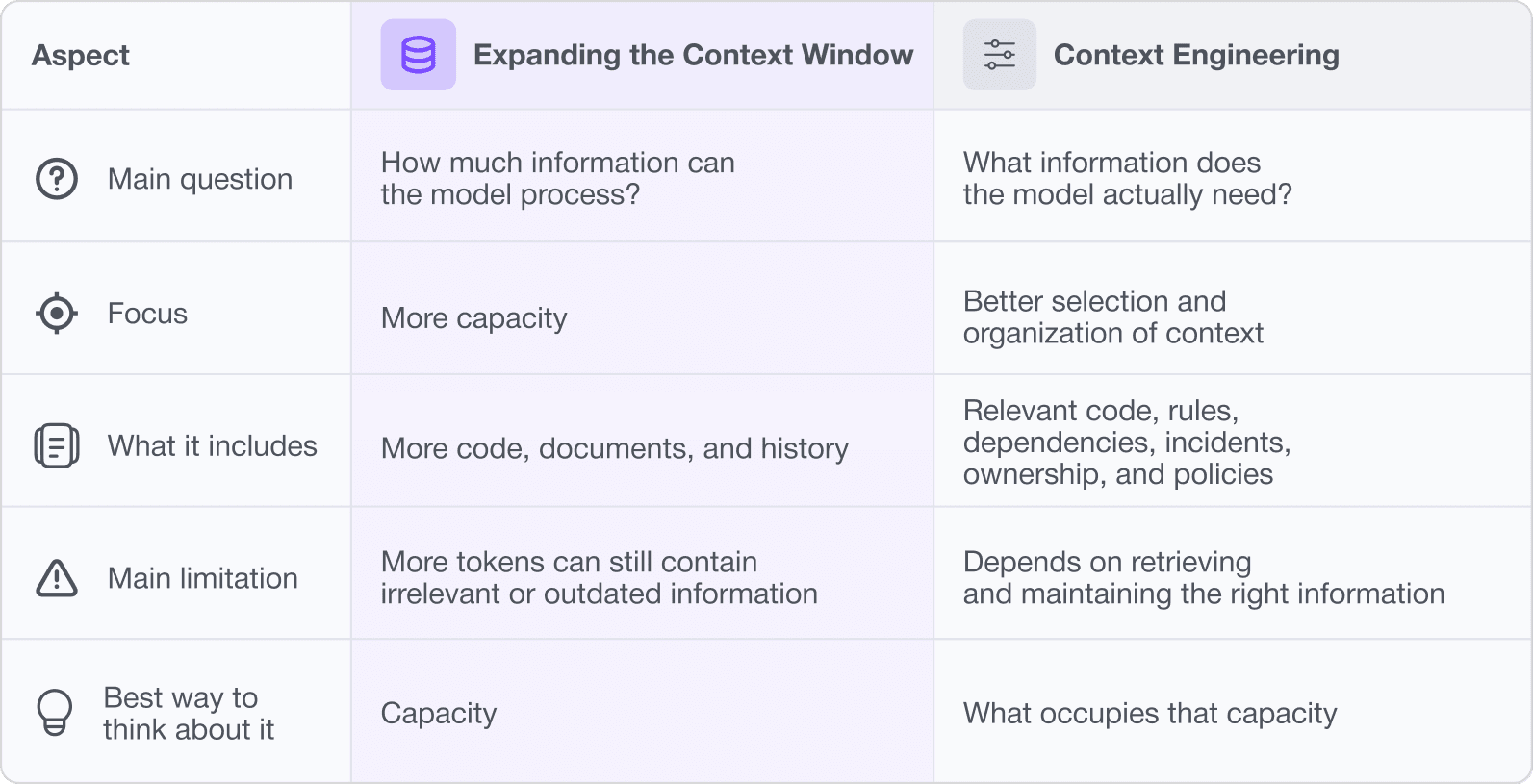
The context window determines how much information can fit; context engineering determines which instructions, knowledge, tools, and task state should occupy that capacity. Larger windows can support the process, but they do not replace task-specific selection.
DesignVerse approaches this problem through its Engineering Context Layer, an enterprise context layer for AI development tools that connects inputs such as design systems, engineering standards, architecture patterns, business logic, and existing software systems so those constraints can inform software production.
Conclusion
Token capacity is easy to compare. It's one number next to another on a spec sheet. The harder question is whether an enterprise has the systems in place to make its own knowledge useful to AI when a task actually depends on it.
That takes more than giving a model extra room to work in. Organizations need a dependable way to connect the standards, decisions, constraints, and relationships that shape how their software runs day to day.
For enterprise teams, that connection work is the real measure of AI readiness, not the size of the window. A bigger window can hold more. What decides the output is what the organization puts behind it: current standards, real dependencies, and the institutional memory the model can actually reach.
Teams checking where they stand can start small: pull one recent AI-assisted change and trace how much missing context the reviewer had to fill in by hand. That single exercise usually shows whether the real gap is capacity or context.
FAQs
What is a context window in AI?
A context window is the token capacity available to a model for an inference request. It accommodates material such as instructions, conversation history, and retrieved content, with generation subject to the model's limits. It doesn't independently provide lasting organizational memory.
Does a larger context window mean better AI output?
It can improve output when the task requires information that would otherwise be excluded or compressed. It doesn't guarantee that supplied material is current, authorized, or interpreted correctly. Evaluate performance using representative tasks and known failure cases.
What's the difference between a context window and context engineering?
The window is a capacity limit. Context engineering manages the information used within that limit, including its selection, organization, and updates during a task. The two are complementary: more capacity can support a well-designed context strategy.
Can retrieval-augmented generation (RAG) replace a larger context window?
RAG can reduce the need to include an entire collection by retrieving relevant material. That material still consumes context-window capacity. Some tasks benefit from both retrieval and a larger window, particularly when several documents must be considered together.
How do enterprises give AI tools access to institutional knowledge?
Connect maintained sources such as repositories, decisions, incident records, and ownership data, preserving permissions and provenance. Ask engineers to document consequential exceptions that exist only in memory. Retrieval can expose recorded knowledge; it cannot recover an undocumented decision with certainty.