


The AI Code Review Bottleneck: Why Faster Code Generation Requires a New Approach to Quality
At our SF Tech Week roundtable, engineering leaders agreed on one thing: AI-assisted software development writes code faster than teams can check it. That has created an AI code review bottleneck. Even though code generation got faster, software delivery slows where review begins, and few leaders said they still review AI-generated pull requests (PRs) with full care.
We’re turning that conversation into six articles. This is the first in the series, and it answers one of the questions left open: how do we verify AI output before it reaches customers?
Our answer is simple. More reviewer effort will not fix the problem. Quality controls need to move upstream, so code is constrained, checked, and validated before it reaches a reviewer, so that human attention can go where the risk is. For AI-assisted software delivery, that is the way to keep up.
Key Takeaways
- AI has raised code output faster than review capacity. PRs are bigger and arrive more often.
- Few leaders at our Tech Week roundtable said their teams still review AI-generated pull requests thoroughly.
- More reviewer effort isn’t the solution, because it isn’t scalable.
- The fix is moving quality controls upstream: architecture limits, automated checks, and business-rule validation happen before code reaches a reviewer.
- Human review should target high-risk changes, logic errors, and independent verification.
Why AI Code Review Became the Bottleneck
The 2025 DORA report captured the trade-off of AI-assisted software development: AI use now links to higher delivery speed, but also to less stable delivery. Because of that, trust levels in AI tools reach only 33%, according to the 2025 Developer Survey conducted by Stack Overflow, and 46% of developers don’t fully believe these tools’ accuracy.
Coding may be faster now, but developers’ work didn’t disappear. It simply moved to review.
More Code, Bigger Pull Requests
Faros AI tracked this shift across 10,000 developers in 2025. In its AI Productivity Paradox research, it showed that teams that heavily used AI merged 98% more PRs and that review time rose by 91%.
In just a year, the gap has widened further. The 2026 edition of the same report, which surveyed 22,000 developers, found that PRs are 51% larger and that average review time is five times higher where AI adoption is more widespread.
There’s no surprise here: if more code is generated, each change is bigger, and every change still lands in the same review queue.
Reviewers Have a Human Ceiling
Code review has a known limit. The SmartBear and Cisco study behind most code review guidance found that reviewers catch fewer defects once a review goes beyond 200 to 400 lines.
AI-generated PRs often pass that limit. As a result, bigger changes get a shallower read by default, because there’s only so much code a person can read at any given time.
"Almost Right" Code Hides Where Reviewers Look Least
When asked to name something that passed engineering review but missed the business intent, one of our Tech Week participants mentioned their product that reads and interprets code, saying that “9 times out of 10 we get it right, but one time we miss”.
AI-generated code often looks fine. However, CodeRabbit's analysis of 470 open-source pull requests found that AI-co-authored changes had about 1.7x more issues overall and 75% more logic and correctness issues than human-only changes.
AI output that is almost right but not quite seems like a non-issue at first glance, but it was actually named by 66% of developers surveyed by Stack Overflow in 2025 as their top problem. That’s because those types of errors are the hardest to catch when a reviewer is overworked. They see clean code, approve it, and then that code fails the one time it really couldn’t.
Why More Reviewer Effort Won't Fix It
The natural response to a review backlog is to push harder on reviews. Hire more reviewers, add an AI code-reviewing tool to the stack, or even go back to line-by-line checks.
Each of these options adds capacity to the same step, yet none of them changes the code-generation-to-review ratio. If generation keeps getting faster and we still check quality last in the review process, even a team that doubles its effort will still have too much code review than it can handle.
And that’s not the only problem. A review can only check against what the reviewer knows. Every large codebase operates based on rules that nobody has written down: which library to avoid, which service should never be called directly, and which edge case caused a production issue two years ago.
Most of the time, the AI that generated the code doesn’t have that knowledge. Plus, a reviewer who lacks it may approve code that breaks the system. Asking reviewers to try harder doesn’t add the missing piece of the puzzle. And as we've argued before, better models alone won't fix it either.
So, what will?
A New Model for AI Code Review: Move Quality Upstream
Quality is cheapest to enforce before and during generation, not after it. Faros AI's 2026 report makes the same case: fix quality at the authoring stage, not downstream. In practice, this means having three layers of control in place, each of which runs before anyone opens the PR.
1. Architectural Constraints at Generation
The first layer shapes what the AI writes. Before generating code, the AI gets the company's approved patterns, libraries, service boundaries, and conventions. This way, the output aligns with the architecture from the get-go instead of being corrected in review.
This is what an engineering context layer does. It turns standards that live in documents and people's heads into rules the AI works within. It is also why context engineering matters more than a bigger context window: the point is to give the AI the right rules, not more rules.
This is context-aware code generation in practice. A reviewer no longer spends time asking why AI used this library or why it called that service directly. Instead, those questions are settled before the code even exists.
2. Automated Checks Before Review
The second layer catches what slips through. Linters, type checks, unit and integration tests, security scanning, and dependency policies all run in CI, before any person is asked to look at the code.
These checks are not new — what changes is their role. With AI output, they become the main filter rather than a backup. Industry analysis of AI-generated defects notes that CI tools enforcing formatters, linters, and style guides can remove whole categories of AI-driven issues.
PR size limits belong here too. If review quality drops past a few hundred lines, the pipeline should flag or split larger changes into smaller ones before they reach a reviewer.
3. Business-Rule Validation
The third layer targets the “almost right” problem. Code can pass every generic check and still break a business rule: a payment rounded the wrong way, a record visible to the wrong user, or an approval step skipped.
The answer is to encode the rules that matter as checks. Definition-of-done criteria, QA test definitions, data-handling rules, and domain invariants become automated tests, so that edge cases that a skimming reviewer would miss get caught easily.
Targeting Human Review Where the Risk Sits
Once upstream controls handle the routine checks, human review can do what it does best: apply its judgment to changes where a mistake is expensive.
That means review depth should follow risk, not arrive evenly on every pull request. A simple three-tier model works for most teams:
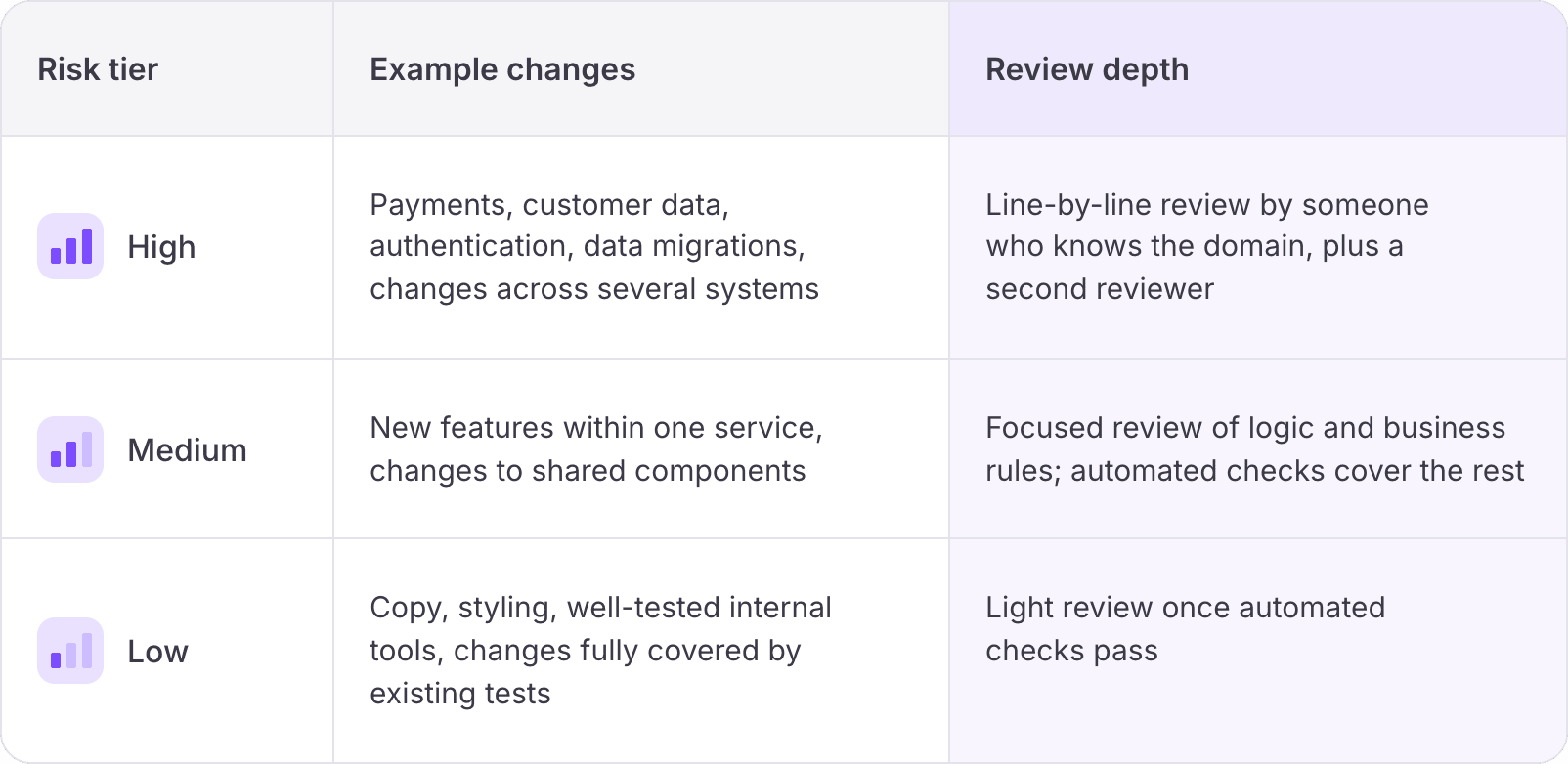
The tiers should be set by the team, written down, and enforced by the pipeline where possible. Code owners, path-based rules, and labels can then route high-risk changes to the right reviewers automatically.
This process is part of AI development governance for engineering teams: deciding in advance where human judgment is required, instead of hoping reviewers spot the risky change in a busy queue.
What Upstream Controls Can't Do
Moving quality upstream is not a promise of bug-free code, but it’s a worthwhile effort.
Upstream controls reduce how much reaches review and how much of it is wrong. They don’t remove logic errors. An AI working within the right architecture can still misread a requirement, and a test suite can still miss a case nobody thought of.
This is why independent verification stays in the process, especially for high-risk changes:
- Tests written apart from the code, so the same mistake doesn't shape both.
- A human reviewer before production for anything in the high-risk tier.
- Monitor production to quickly find and correct errors.
The goal of upstream controls isn’t to remove humans from code quality checks. Instead, it’s to allow them to stop steering their attention to problems a system could have caught, so that they can focus on the problems only they can solve.
Conclusion
The AI code review bottleneck is not a reviewer problem. Code review is a process initially built for human-speed output that now receives AI-speed output.
Fixing this bottleneck means making structural changes. Constrain code generation within the company's architecture and standards. Let automated checks and business-rule validation filter what follows. And finally, point human review at the changes where risk sits, and keep independent verification in place for them.
DesignVerse was built around this. It generates code within your existing architecture, and it versions and traces every change, so the review starts from code that is already aligned with your business standards.
If your review queue is too long, calculate how much engineering drift is costing you, then request a demo to start fixing it.
FAQs
What is the AI code review bottleneck?
AI produces more pull requests, and larger ones, than reviewers can check at the same depth. Review capacity has not grown with generation, so either review time rises or review quality falls.
Can AI code review tools solve the bottleneck?
They help. They can catch some issue types and triage a busy queue. But they are still a downstream check, so they work best alongside upstream controls and human review of high-risk changes.
What does moving quality upstream mean for AI-generated code?
It means enforcing architecture, standards, and business rules before and during generation, and in automated checks, so fewer problems reach a human reviewer.
Does moving quality upstream remove the need for human review?
No. It reduces how much reaches review and lets reviewers focus. Logic errors still happen, and high-risk changes still need independent verification before production.
Which changes still need thorough human review?
Changes that touch payments, customer data, login, or data migrations, and changes that span several systems. These carry the highest cost if something is wrong.