


The AI Coding Drift Report: What 15 Enterprise Codebases Reveal About AI-Generated Code
You've seen it. An engineer asks an AI agent to make a change. The code comes back fast and clean. It compiles. It passes review. Then it fails in QA. That's the problem with almost-right AI-generated code: it looks convincing until it meets the reality of your engineering environment.
This gap is expensive, but almost no one is measuring it. So we did.
Our AI Coding Drift Report benchmarks AI engineering across 15 private enterprise codebases, measuring what happens when AI agents work without organizational context compared with a context-engineered approach.
The results reveal a substantial gap in accuracy, consistency, and the amount of code an agent needs to read before it can produce accepted work.
What We Tested
The AI Coding Drift Report tests AI where it’s most challenging: 15 private enterprise codebases in aviation, banking, defense, software services, and consultancy. Each is 15–20 years old, over a million lines long, and written mainly in Ada, C++, and COBOL. They are private enterprise repositories, not public code that models could have learned from.
We ran two unmanaged frontier agents and a context-engineered system on the same real tasks, with the same prompts and the same graders. Same exam. Only one candidate got the briefing pack. This wasn't a test of model intelligence in isolation: it compared complete engineering setups, with and without structured organizational context.
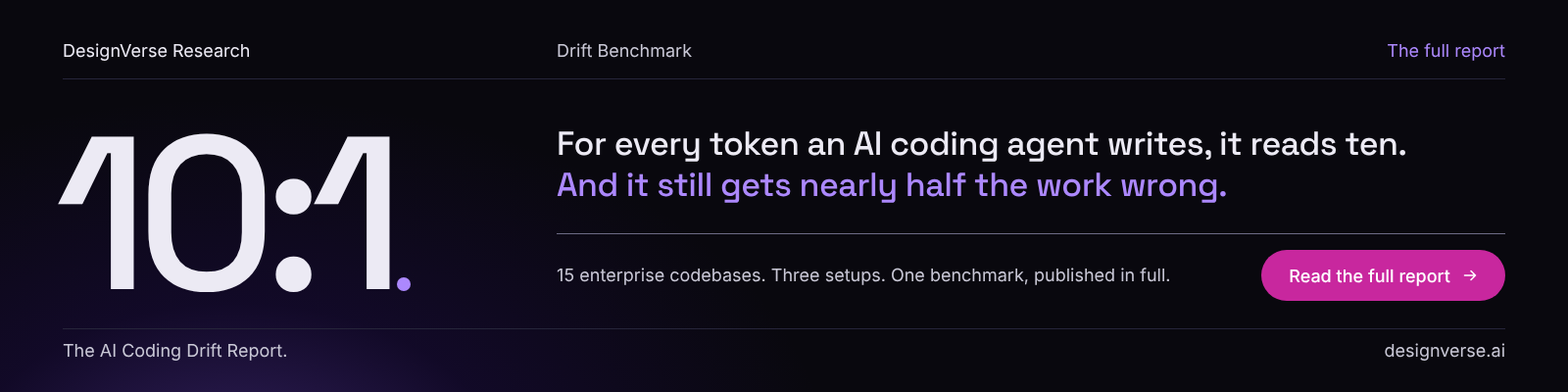
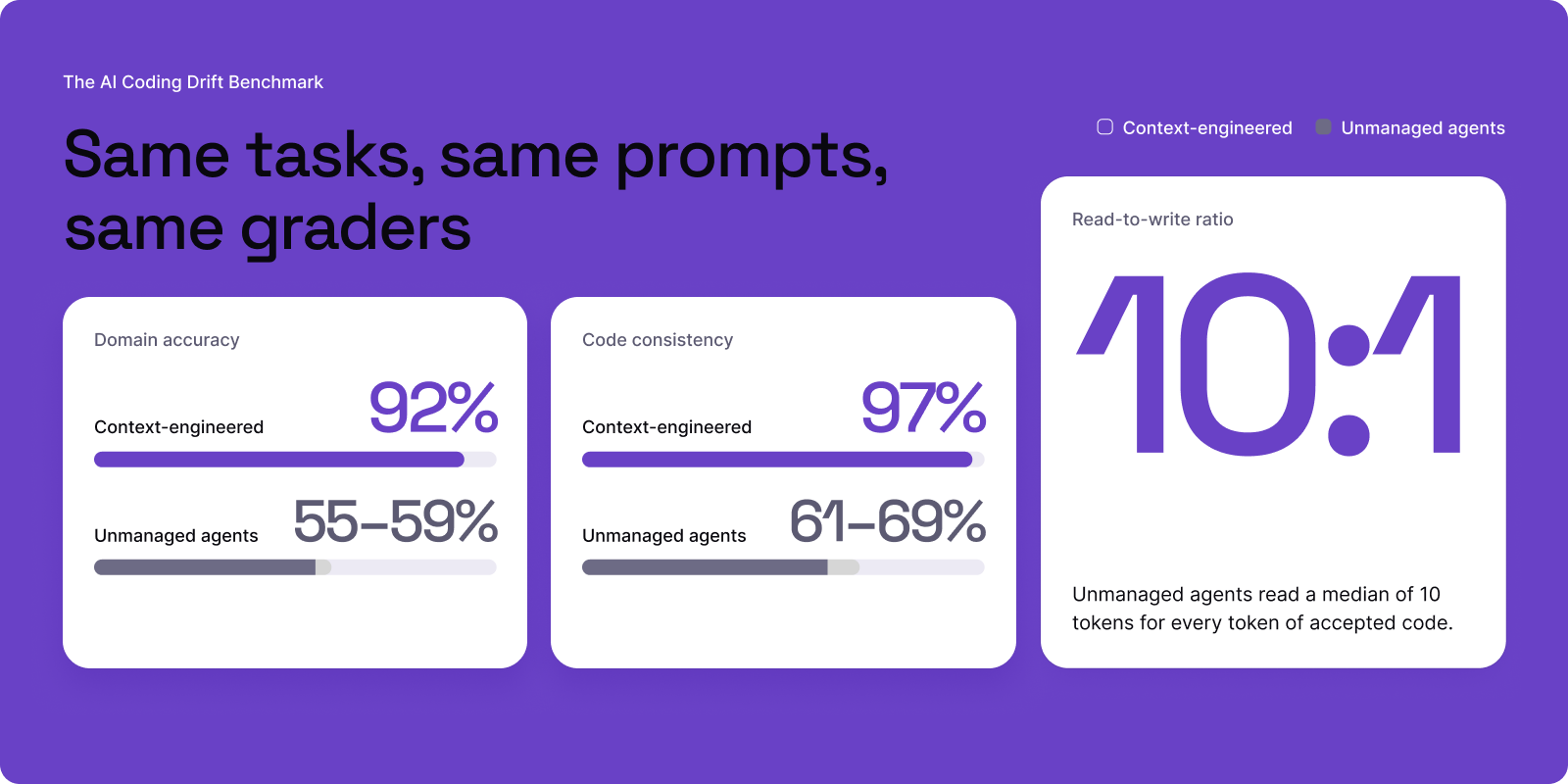
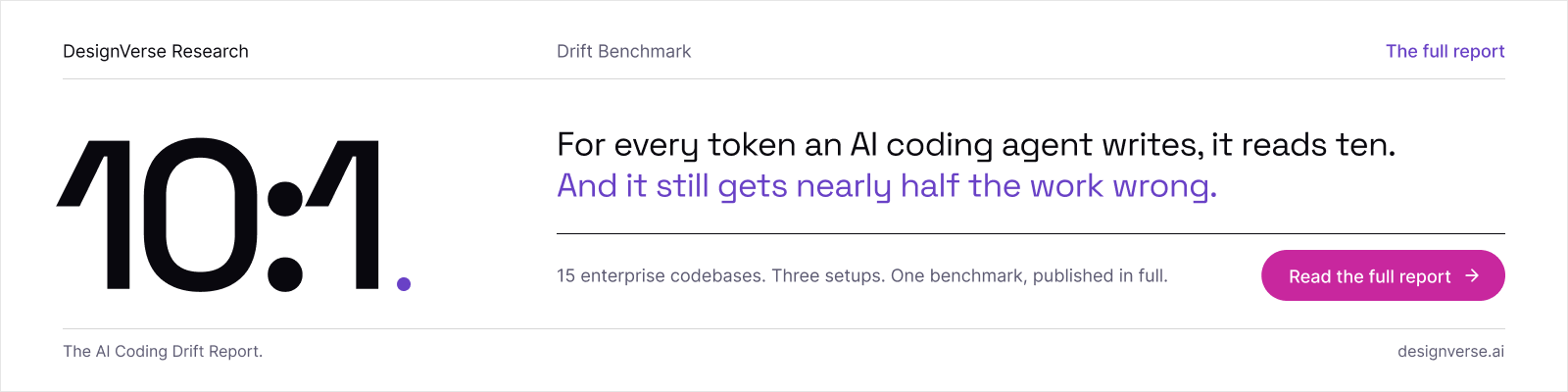
- Reading: Without context, agents read a median of 10 tokens for every token of accepted code. We call this the Engineering AI Drift Index.
- Accuracy: 92% with context, 55–59% without. Right 9 times in 10, against a little over half.
- Consistency: Ask the same thing twice. With context, 97 answers in 100 matched. Without it, about 2 in 3.
The frontier agents were highly capable. Unmanaged, none of them came close.
What the Benchmark Reveals
- Context changes accuracy. The context-engineered system achieved 92% domain accuracy, compared with 55–59% for unmanaged frontier agents.
- Context improves consistency. Repeated tasks produced matching answers 97% of the time with context, compared with 61–69% without.
- Unmanaged agents read heavily before they write. Their median read-to-accepted-code ratio was 10:1.
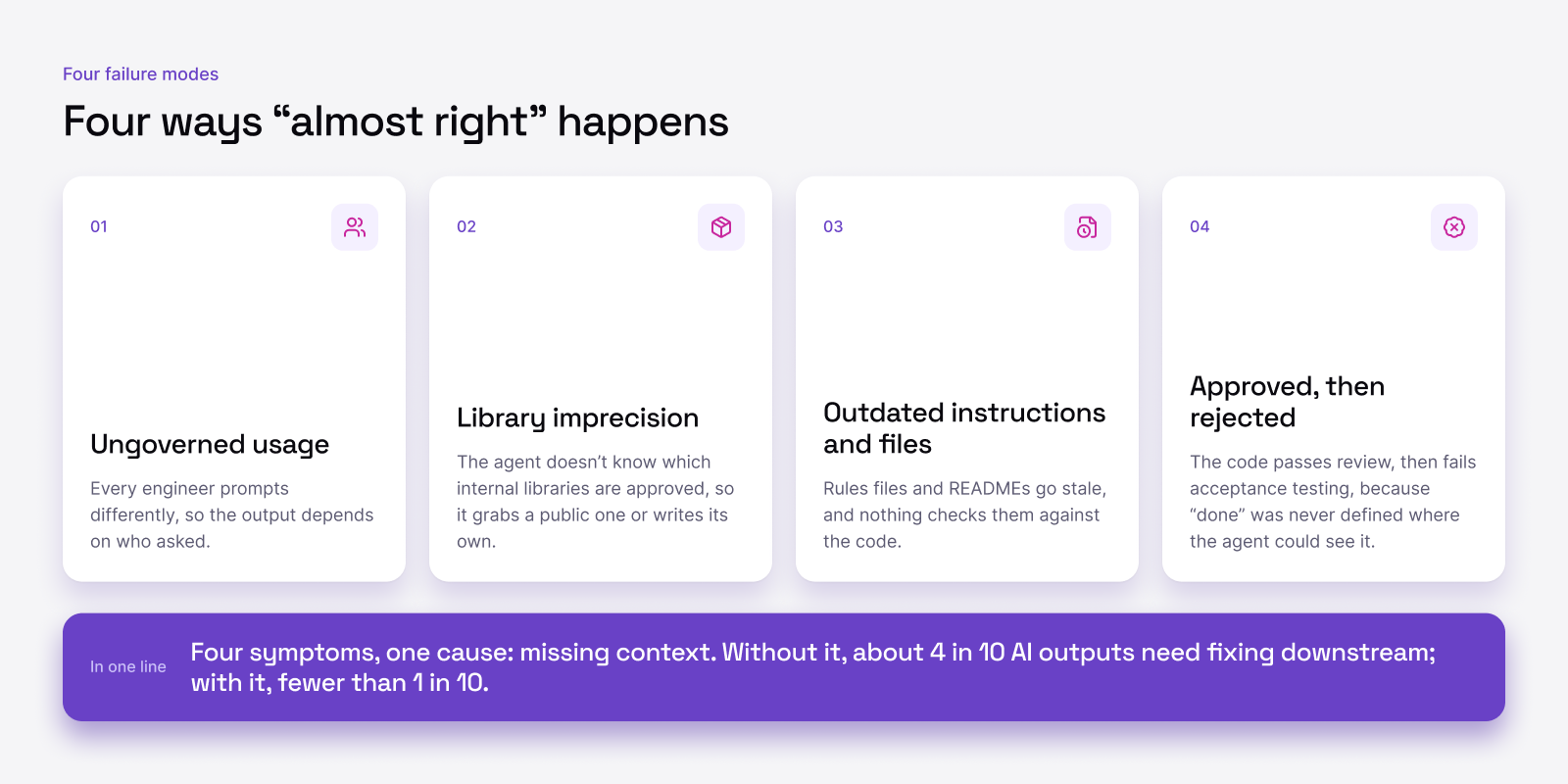
- Four recurring failure modes explain much of the drift. Ungoverned usage, library imprecision, outdated instructions, and "approved, then rejected."
- Better models aren't the whole answer. Maintaining engineering context is a critical part of reliable AI-assisted development.
Four Ways AI Coding Drifts
Trace the rework back, and it falls into four patterns. Each is the AI missing something the team already knew.
- Ungoverned usage: Without shared instructions and standards, different engineers get different results from the same tools.
- Library imprecision: Without knowledge of approved internal libraries and reusable components, agents reinvent existing functionality or select unsuitable alternatives.
- Outdated instructions: Documentation and configuration files become disconnected from the current state of the codebase.
- Approved, then rejected: Agents produce work that appears complete but doesn't meet the requirements of the engineering team.
Four symptoms. One cause: missing context. Without it, about 4 in 10 outputs were wrong for the codebase; with context, fewer than 1 in 10 were.
The Fix Isn't A Better Model
It's tempting to wait for the next model. But the next model hasn't seen your codebase either. Swap the model, and the gap moves somewhere else.
What closes it is a maintained engineering handover: a continuously updated source of truth about how your systems work, what conventions they follow, which components already exist, and why important decisions were made. Every AI coding tool reads it before it writes, and it gives them something public training data can't: an understanding of the environment they're working in. The gap it closes has a name: engineering drift, and you can calculate the cost of yours here.
The report sets out five practices, each matched to one failure mode, plus a two-week test you can run on one module of your own codebase. You don't need us to run it.
Find Out Why AI Gets Your Code Almost Right
The AI Coding Drift Report shows what happens when AI agents work without engineering context, and what changes when that context is provided systematically.
Inside the report:
- Original benchmark results across 15 private enterprise codebases
- A side-by-side comparison of three approaches to AI-assisted engineering
- The four failure modes behind AI coding drift
- Five practices for improving the reliability of AI coding
- The complete methodology, scoring rubric, and run specification
- A two-week experiment you can run on your own codebase
FAQs
What is AI coding drift?
AI coding drift is the gap between what an AI coding tool generates from general programming knowledge and what is actually correct in a specific engineering environment. It happens when the tool lacks reliable knowledge of the codebase, internal standards, approved components, and architectural decisions. Read more about engineering drift.
What does "almost right" AI code mean?
Code that works in general but not in your system. It compiles and passes review, then fails in QA or production because it used the wrong library, ignored a team convention, or rebuilt something that already existed.
Why doesn't a newer or bigger AI model fix it?
Because the missing piece isn't skill. It's information. A newer model has never seen your architecture, standards, or past decisions either. In our benchmark, highly capable frontier agents scored 55–59% on domain accuracy without context. The context-engineered system scored 92%.
Isn't a longer context window enough?
No. Fitting more of the repository into a prompt doesn't tell the model which parts matter, which patterns are current, or why decisions were made. We explain the difference in Context Windows Aren't Context Engineering.
How was the benchmark run?
The benchmark evaluated three AI engineering setups across 15 private enterprise codebases, each 15–20 years old and over a million lines, covering eight categories of real engineering work. Two unmanaged frontier agents and a context-engineered system got the same tasks, prompts, and grading criteria.
The results compare complete engineering setups rather than isolating the effect of context on an otherwise identical model. The report publishes the full methodology, scoring rubric, and run specification so you can assess the comparison yourself.
Do we have to replace the AI tools our team already uses?
No. The fix is giving every AI model and tool your team uses the same up-to-date knowledge of your system. Your engineers keep the tools they know.
How can we see whether this applies to our team?
Two ways. Run the two-week test from the report on one module of your own codebase. Or use the Cost of Drift Calculator to estimate what almost-right code costs your team in about two minutes.